
Social Media Musings
V for Verify in this case. It’s a sensitive topic with large social media firms proposing subscription plans, and people worried about what that means, hopefully this can provide some help.
What does verification mean?
Being verified on a social media platform shows that an account which claims to be you really is you.
In the age of impersonations (for good and for ill), there are bot accounts, parody accounts, social engineering impersonators, fan accounts, replacement accounts after being hacked, character accounts, and secondary accounts “for when the platform mutes my main account.” A person might need to confirm to others that they are the person behind a particular account. For most people, this would be handled offline – in person, over the phone, in an email to one’s friends confirming them that a given account is them.
The concept of social media verification came in 2009, when Twitter introduced the blue checkmark for active, notable, and authentic accounts. Twitter had few rules on parody and fan accounts, and certain accounts impersonating the likes of Kanye West, Aerosmith’s Steven Tyler, and St. Louis Cardinals manager Tony La Russa had grown to the point that La Russa sued Twitter.
Over the next several years, other social media outlets followed. And now in 2023, we’re seeing likely changes to the user cost and services provided by verification from the likes of Meta and Twitter.
What is the benefit of verification?
The primary benefit is that it verifies this social media account is part of your identity. People who want to read your words or view your content can rest assured that they not following someone pretending to be you. This protects both you and your followers.
It protects your reputation. An impersonation account that claims you do immoral or reprehensible activities could result in a dramatic loss of followers. This in turn could cause a loss in income, whether direct in a follower-based monetization of YouTube or TikTok, or indirect through a loss of job, deal negotiations for lesser amounts, or a boycott of your company’s products and services.
It protects the people who consume your content – the people who follow, watch, and listen to you. Impersonators prey on people all the time. Recently, we’ve heard of a principal who resigned after a four-month long con by someone pretending to be Elon Musk, but apparently that’s the tip of the iceberg.
Who should verify? (Should I verify?)
While verifying your social media accounts sounds like a good thing, I don’t think it’s for everybody. It all depends on how large your friend or influence group is, and how much damage could someone do by pretending to be you.
Did you know that risk can be expressed as a mathematical formula? It’s pretty simple, too: Risk = Likelihood * Impact.
I know, clear as mud. Let me show how it applies. “What is the risk associated with someone pretending to be me on social media?”
Likelihood is a percentage, from 0% to 100%. To assign a value to this, ask, “How often is it that someone tries to impersonate me on social media?” The answers could range something like this.
- Not at all. That I know about. (Close to 0%.)
- “My nephew told me they got a phishing letter from someone pretending to be me once last year.” (Around 10-15%)
- “Every six months or so, one of my FB friends asks if a cloned account is me. Another bot trying to be me and spread political junk.” (About 25% – infrequent, but repeating).
- “Work catches a few emails each quarter from someone trying to be me and get Payroll to change my bank info. ” (About 50%.)
- “Someone set up a fan account and reposts photos of me from my shows every month.” (Over 50% at this point.)
- “I run a corporation. Not only do people try to get my salary through ACH changes, they try to pretend to be me to get my employees to send them gift cards, and they send emails to Accounting trying to get them to approve fake “new vendor” invoices for $50K aa pop.” (Close to 100%)
- “There are at least three fan accounts of me, two parody accounts making fun of me, and my 500K followers send me notices of scam accounts also using my name / picture.” (Close to 100%)
Those last couple examples illustrate what kind of impact you have due to reach or financial responsibility. Impact is a dollar amount – the average amount you (or others) would lose due to the risk event. This could be a direct less as in an ACH fraud, or it could be in lost sales, company downtime, etc.
Therefore, the risk of an event happening once is the cost associated with the event’s impact times the percent chance you assigned to its likelihood. If you can’t decide on a percent chance, multiply by its frequency – how many times it will likely happen in a year, which is the same duration of most new verification subscription services.
For most of us, we’re talking our own paltry bank accounts or one case of someone spending $50 on gift cards because they thought they were talking to you. It’s just not that much of a risk. Plus, most of us can notify everyone we know easily when we have a new account. In our case, verification isn’t for us.
Now consider folks who have a large number of followers, or who are the executives who represent a company. If someone impersonated a celebrity, claiming they had a new charity or medical issue to goad people into donating $5 each — a $5 impact times 200,000 who fell for it is a $1 million risk!
For these folks, social media verification is not just a GoodThingtm, it’s a necessity!
What is the cost of verification?
What we’re seeing now is the cost to the user of a subscription. I’d like to flip this on its head. “How much does it cost a social media company to provide a verification service?” I reached out to Bing’s AI / GPT tool for this and got a regurgitation of my question as the answer (pic below). I found some articles and data reaching back to 2008-2011 regarding the E-Verify service for employers to verify that employees are US citizens, but as these were in articles by third party competitors and 12-15 years old, the numbers aren’t useful.
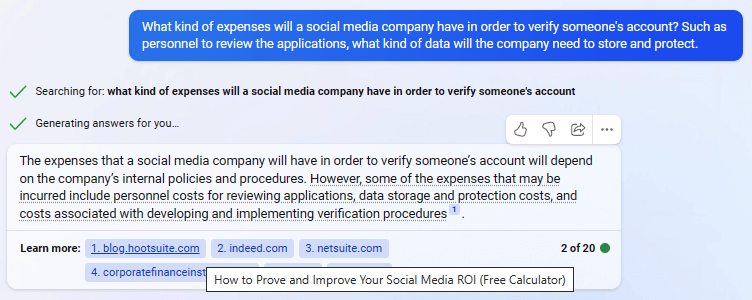
I’d already come up with the biggest costs. Each social media company offering verification has to 1) dedicate employee time to processing each request and 2) decide what data they can keep and how to protect it. The AI also suggested 3) the employee time dedicated to “developing and implementing verification procedures.”
The more people who request to be verified, the more employees (or the faster an automated process) you need to return a result to each person in a timely manner. Also, if you are storing things like names, contact info, and/or a proof if identity like a driver’s license, then not only do you have to store these, but you have to work within data protection acts like GDPR, CCPA, CDPA – particularly as most of these large social media outlets are publicly-held.
And yet, once you’ve done the work and verified the person, there’s nothing that compels the person to be re-verified. No renewals such as with a driver’s license or passport. This means only a one-time surge of income for the social media company, which isn’t a sustainable business model.
What about these subscriptions?
Thus the idea of subscriptions – this keeps money coming in over time, which is a sustainable model. But since the process of verification itself is discrete – it happens only once – the company needs to offer something else to make it worth a recurring fee.
Now, I’m not one to say whether these services and fees below are “worth it.” But for you to have an informed view, here are some popular social media types, their verification plans and benefits as of April 2023, and the links where I found them.
Twitter – “new” Twitter Blue
- Source: About Twitter Blue, Twitter.
- Cost:
- “Web” – $8/month or $84/year (12.5% discount)
- iOS/Android app stores – $11/month or $114.99/year (12.9% discount)
- App store prices pass along the Apple/Android store fees to you.
- Benefits:
- Blue checkmark for account verification.
- 50% fewer ads.
- Various tweet enhancements: Longer limit, text formatting, longer video upload.
- Limited ability to edit or remove recently-sent tweets.
- Ability to display owned NFT images within your profile.
- Color themes
- Bonus impact to interacting with others’ tweets.
- “Optional MFA using SMS”. Not sure on this, as my Twitter account already has MFA using an app.
Meta (Facebook and Instagram)
- Source: Introducing Meta Verified, Meta
- Cost:
- “Web” – $11/month (FB only), no yearly option.
- iOS/Android app stores – $14/month, no yearly option.
- App store prices pass along the Apple/Android store fees to you.
- Also, must separately subscribe to be verified on both FB and IG.
- Benefits:
- “Verified” badge – uses government ID to verify.
- “Proactive account monitoring” that claims to protect against impersonators.
- Required two-factor authentication.
- Access to live chat and account support.
- 100 Stars / month – in-app currency that you can send to content creators. 100 stars = $1 US.
- Exclusive stickers to use within posts (or pics?).
YouTube
- Source: Verify Your YouTube Account, YouTube Help
- Cost: None. Simple phone number verification.
- Benefits:
- Upload videos longer than 15 minutes
- Add custom thumbnails
- Live stream
- Appeal Content ID claims
- Source: New Verification Features, LinkedIn Blog
- Cost: None
- Benefits:
- CLEAR: Confirms government ID to prove your identity.
- Entra: Uses your company email address to confirm current employer.
TikTok
- Source: Verified Accounts on TikTok, TikTokHelp
- Cost: None. Follows legacy Twitter “Active, Notable, Authentic” model with “Secure” (has email-backed MFA) and “Complete” (public and all fields filled).
- Benefits:
- Verified badge.
Tumblr
- Sources:
- Selling blue checkmarks, The Verge
- The Important Rainbow Internet Checkmarks, Tumblr Mart
- Cost: $8 one-time fee for two checkmarks. (Repeatable?)
- Benefits:
- Profile badge that may turn into crab icons later.
Mastadon (not popular, but I have an account)
- Sources:
- How we verified ourselves, The Markup
- Cost:
- None
- Requires ability to add a link to a webpage you run.
- Benefits:
- Green checkmark with name of vouching website.
- “Mastodon makes no claims about who an account belongs to, just that a particular website has vouched for it.”


One response to “To Ve(rify) or Not to Ve(rify)”
[…] To Ve(rify) or Not to Ve(rify) to understand that the social platforms already have a monetized […]
LikeLike